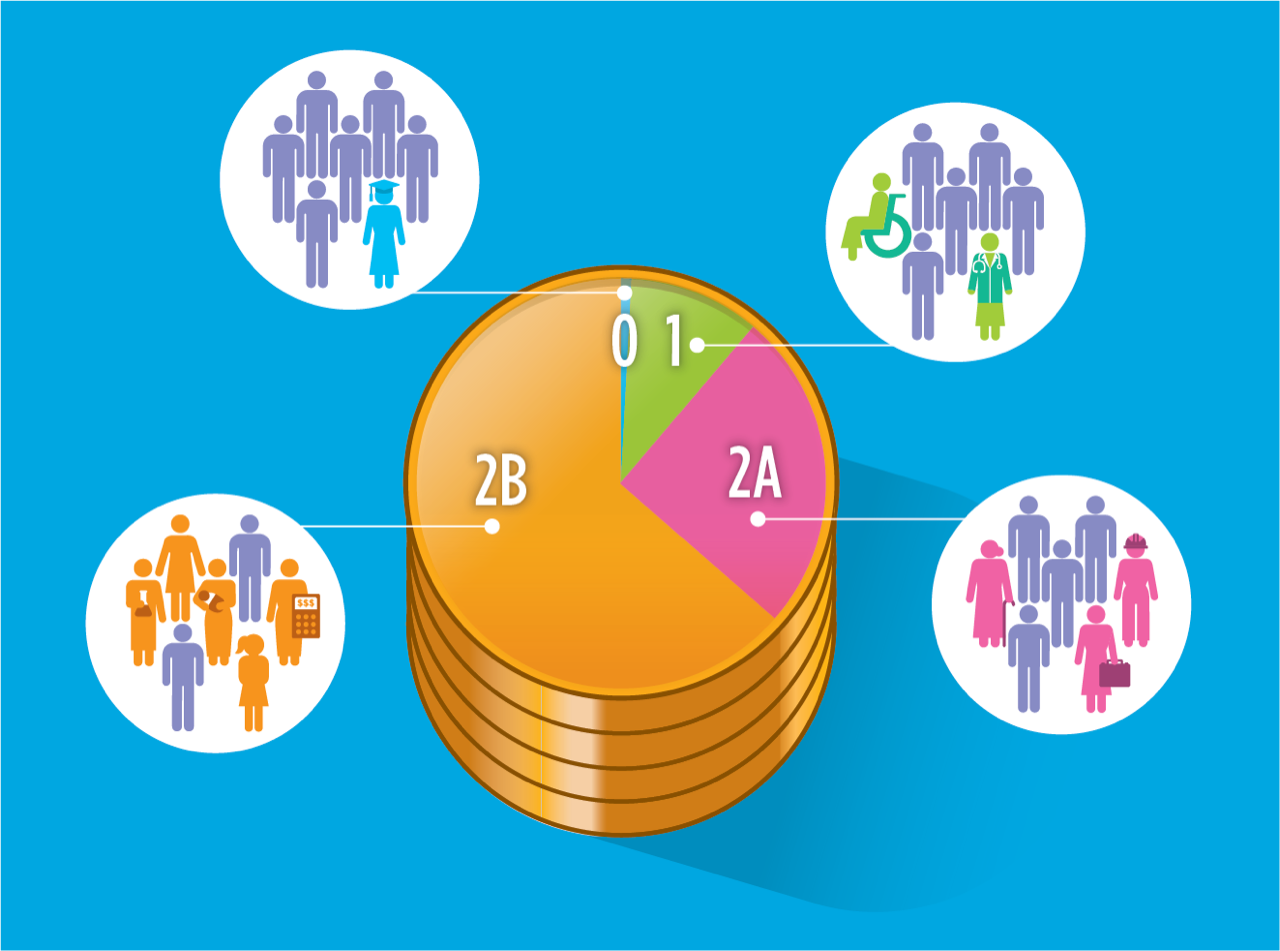
The Gender Equality Marker (GEM) was made a mandatory standard for UN entities in 2012 through the implementation of the UN-SWAP.
The GEM is a tool to track financial allocations and expenditures according to their contribution to gender equality and/or women’s rights (GEWE). It has the potential to document investments being made in GEWE by the entire UN system and by individual entities. It can help identify where the investments are happening and where there are gaps.
GEM in Brief
The GEM was first made a mandatory standard for UN entities in 2012 through the implementation of the UN-SWAP.
In 2018, the Secretary-General established the High-Level Task Force (HLTF) on Financing for Gender Equality to harmonize the application of the GEM in defining financial targets and increasing the resource base for gender equality and women’s empowerment (GEWE). Recommendations from the HLTF expanded the GEM across the UN system (at the entity level, UN Country Team level, and in the inter-agency pooled funds level). Check the brief of the GEM application in 2021.
In 2023, CEB-endorsed the Data standards for United Nations System-wide reporting of financial data with the gender marker as the 7th standard. This standard is being applied system-wide with a transitionary period of 3 years.
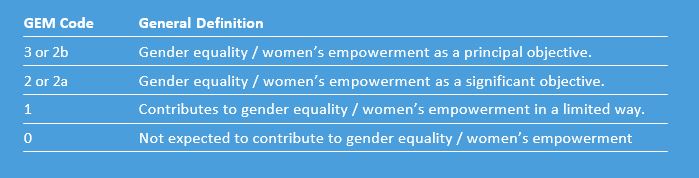
The GEM uses a four-point scale coding to signal contributions to GEWE as a principal objective, as a significant but not principal objective, in a limited way or with no expectation to contribute to gender equality and/or the empowerment of women.
Here you can find a presentation on the GEM and financial targets for ITC-ILO Course “Gender Responsive Budgeting within Organizations” in 2022.
Applying GEM in UN Entities
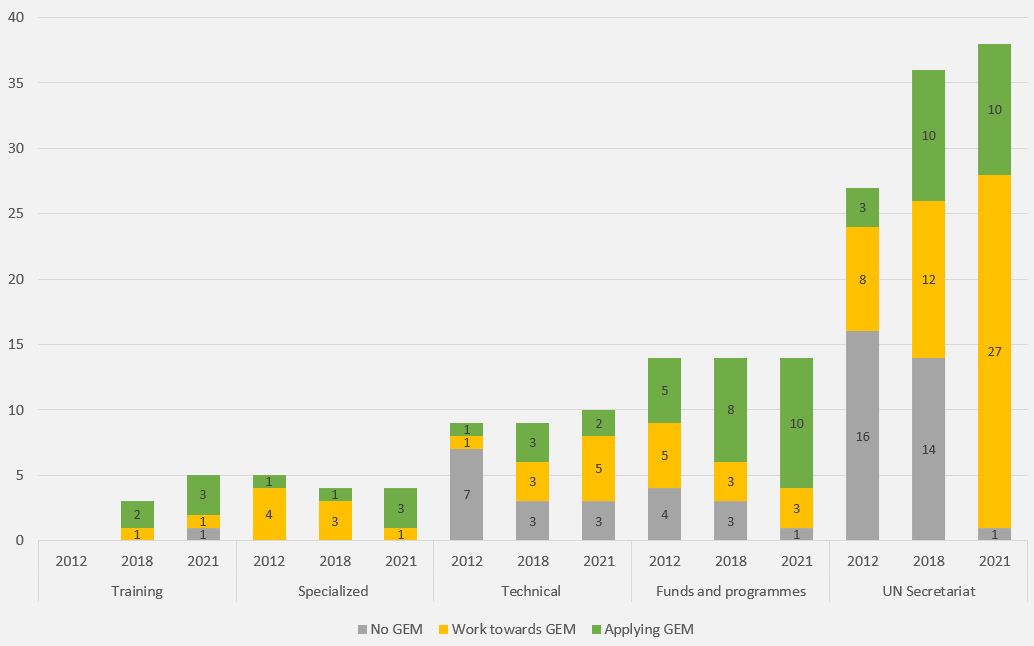
At the entity level, by 2023, 38 UN entities are implementing the GEM, compared with 24 entities in 2018 and 10 entities in 2012.
Check the below chart for the GEM implementation at the UN entity level, per typology of entities in the period 2012-2018-2022, and the experience from entities in implementing the GEM: UNIDO, UNFPA, UN DPPA, UNICEF, UNDP, Peacebuilding Fund, ESCWA.
Applying GEM in UN Country Teams
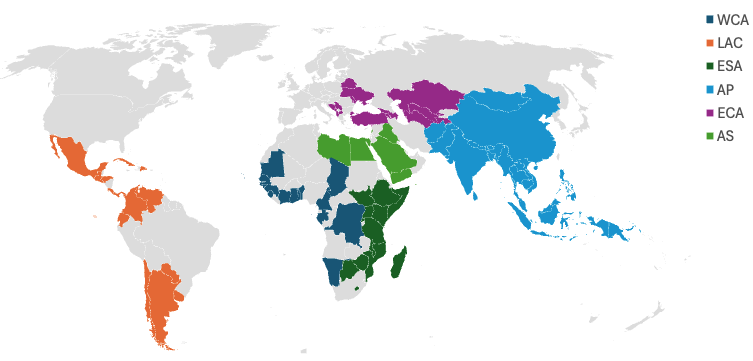
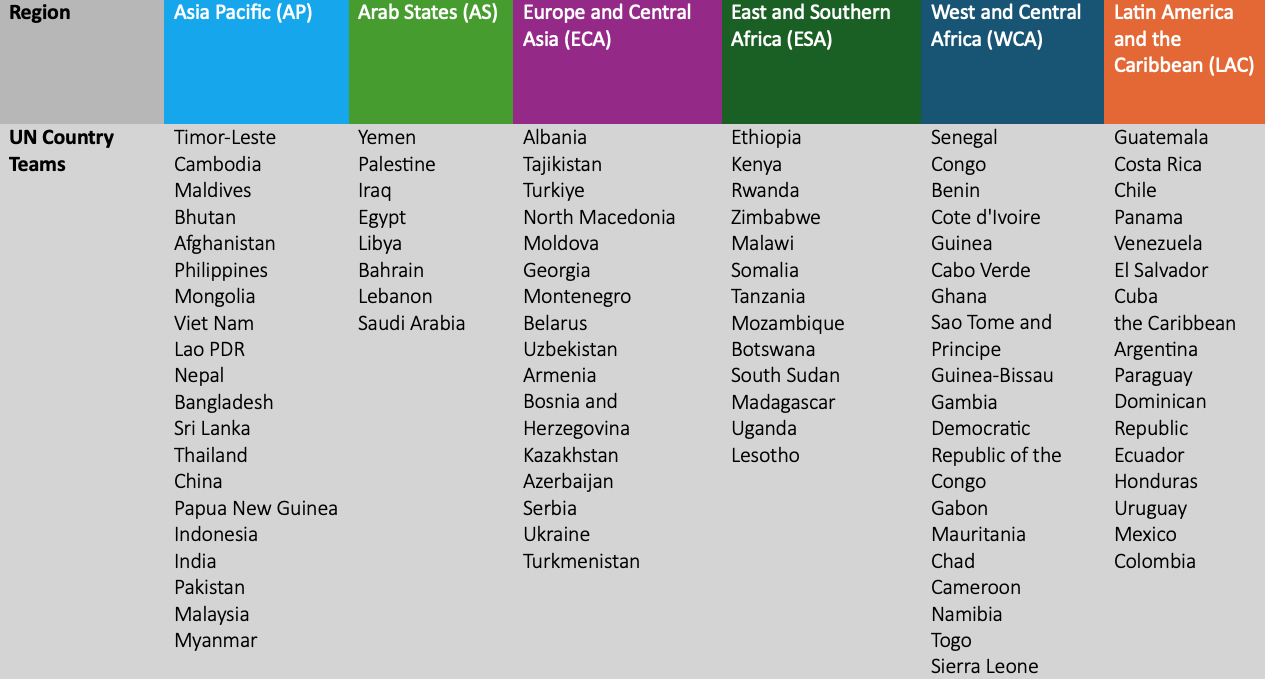
At the UN Country Team (UNCT) level, by 2023, 91 (or 70%) UNCTs out of 130 have applied the GEM in their Joint Work Plan, up from 43 UNCTs in 2020.
The inter-agency UNCT-Gender Equality Marker (UNCT-GEM) is a UNSDG tool to track UNCT support to gender equality in the context of the UN Cooperation Frameworks (CF), it was introduced in UNCTs with the rollout of the UN INFO digital reporting platform in 2018. A financial threshold of 70% of available resources towards gender equality activities (GEM 2 and GEM 3) was introduced in 2021 (QCPR indicator 1.4.18), in 2023, 37 UNCTs or 41% out of 91 UNCTs that apply the marker reported to reach this target.
Regional distribution of UNCTs implementing the GEM, as of 2023.
Applying GEM in Inter-Agency Pooled Funds
Inter-agency pooled financing is a recognised funding modality that is to be applied and implmented by multiple UN agencies in a joint manner. The well-designed and professionally managed pooled funds help strengthen efficient collaboration across entities in the UN development system.
Inter-agency pooled funds can be classified as “Multi-partner Trust Funds” (MPTF) and “Standalone Joint Programmes”, and have undergone steady growth through the years. By 2020, the share of inter-agency pooled funds has grown to US$1.8 billion for humanitarian funds and US$ 1.2 billion for development-related funds.
In 2019, the Secretary-General's High-Level Task Force (HLTF) on Financing for Gender Equality endorsed the recommendation to expand the application of the GEM to inter-agency pooled funds.
GEM in Inter-Agency Pooled Funds
While many pooled funds address gender equality concerns in their relevant documents, less than half include contributions to GEWE in their financial reports.
Since 2021 UN Women has supported the UNSDG Fiduciary Management and Oversight Group (FMOG) Working Group in launching the first survey on common management features to all MPTFs’ Administrative Agents . In the third quarter of 2022 a new survey was conducted for the second time.
The 2022 survey received responses from a total of 150 UN inter-agency pooled funds, equivalent to 79% of the estimated 190 active UN inter-agency pooled funds in 2021. Of the total of complete responses received, 48 (or 32%) were from MPTFs and 102 (or 68%) were from standalone Joint Programmes (JPs).
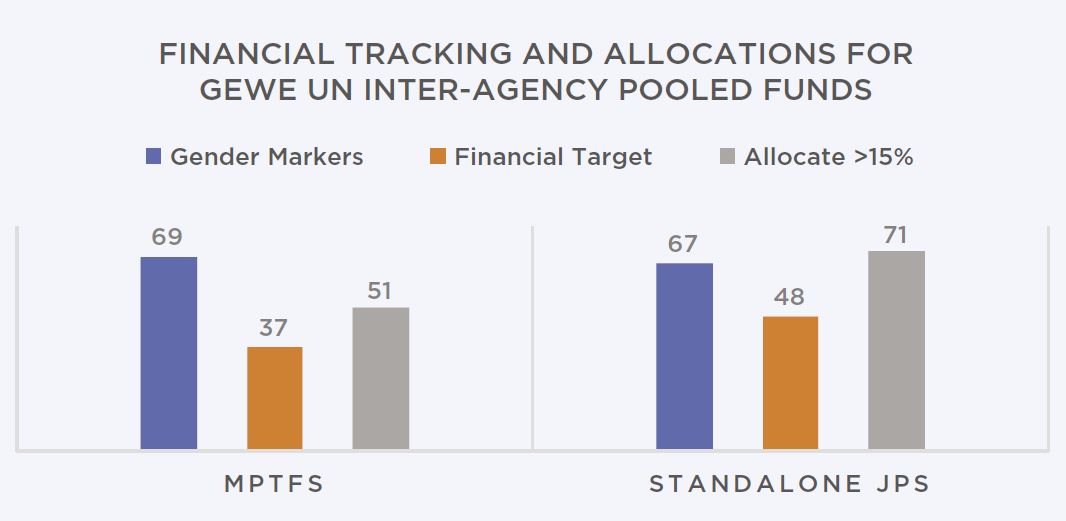
The results of the survey show that 76% of the MPTFs and 71% of JPs are applying the GEM. In terms of financial investments (with or without established targets) 42% of MPTFs and 55% of JPs are allocating 15% or more of their resources to programmes with gender equality as their principal objective.
Percentage of inter-agency pooled funds, active in 2021, responding affirmatively to gender-related questions
For more information on the 2022 survey, please see the Brief: Implementation of Financial Tracking Tools and Financing Commitments for Gender Equality in Inter-Agency Pooled Funds
GEM as a UN Financial Data Standard
The standardization will ensure consistent and timely report on investments in gender equality in the UN system.
Under the principle “maximizing transparency, minimizing efforts” in meeting UN financial reporting obligations, the CEB FBN has discussed the GEM standard (as a four-point scale financial tracking tool) as part of the UN CEB minimum data set for reporting to IATI and OECD. As a result of this effort, in 2023, CEB formally endorsed the Data standards for United Nations System-wide reporting of financial data with the gender marker as the 7th standard. This standard is being applied system-wide with a transitionary period of 3 years.
Harmonization of Code Lists with OECD and IATI
The UN Transparency Task Force recommended additional variables in the UN CEB Minimum data set for reporting to OECD and IATI.
The International Aid Transparency Initiative (IATI) is a global initiative to improve the transparency of development and humanitarian resources and their results to ad- dress poverty and crises. IATI brings together governments, multilateral institutions, private sector and civil society organizations and others to increase the transparency of resources flowing into developing countries. Organizations that distribute or spend resources publish information about their development and humanitarian activities using IATI’s data standard. Entities reporting to IATI include FAO, IFAD, ILO, IOM, ITC, UNEP, UNAIDS, UNCDF, UNDCO, UNDP, UNESCO, UNFPA, UNHCR, UNICEF, UNIDO, OCHA, UNOPS, UNRWA, UN-WOMEN, UNITAID, WFP, WHO, UN-HABITAT.
The OECD Development Assistance Committee (DAC) is a unique international forum of many of the largest providers of aid, including 30 members. They maintain the International Development Statistics (IDS) online databases covering bilateral, multilateral aid (ODA) and private providers’ aid and other resource flows. In partic- ular two statistical frameworks on ODA – Common Reporting Standard (CRS) and Total Official Support for Sustainable Development (TOSSD) - are of relevance for the purpose of unified coding between the UN, IATI and OECD.
GEM training modules
The training modules bring together existing guidance on gender equality markers together with the valuable knowledge and experience that has evolved across different UN organizations with implementing financial resource tracking mechanisms and financial targets. It is intended to provide direction for individual entities instituting or endeavoring to improve their gender equality marker systems.
Resources
Explore the latest updates related to the implementation of the Gender Equality Marker in the UN system.
2022
Implementation of the Gender Equality Marker in UN Entity, Country Teams and Inter-Agency Pooled Funds
This brief seeks to explain the status of the implementation of the Gender Equality Marker (GEM) in the UN system (at the entity level, UN Country Team level, and in the inter-agency pooled funds level).
2018
CEB Guidance note: Coding Definitions for Gender Equality Markers
This document complements and expands on the UNSDG’s Gender Equality Marker Guidance Note (2013).
Together with the Guidance Note on Quality Assurance of Gender Equality Markers (2018), this supplementary guide aims to support UN entities in applying their Gender Equality Markers (GEMs) in an optimal manner. This note elaborates on two Standards that have been the focus of discussion in the last three years: the ‘unit of analysis’ and ‘coding definitions,’ as well as discussing how the coding experience can assist in contributing to gender sensitive programme design.
2018
CEB Guidance note: Quality Assurance of Gender Equality Markers
This document complements and expands on the UNSDG’s Gender Equality Marker Guidance Note (2013).
Together with the Guidance Note on Coding Definitions for Gender Equality Markers (2018), this supplementary guide aims to support UN entities in applying their Gender Equality Markers (GEMs) in an optimal manner. It seeks to encourage inter-agency knowledge sharing and is being developed by the UN-SWAP Gender Marker Working Group of the Finance and Budget Network (FBN), which is chaired by UN Women.
2019
UNCT Gender Equality Marker Guidance Note
This guidance support UNCTs in the application of the GEM within UN INFO and the UNSDCF. The UNCT GEM tracks the resources allocated collectively by the UN system under the UNSDCF cycle, making clear the level of commitment and the degree of resources allocated by the UNCT in support of national GEWE priorities
2020
Guidance Note: UN Covid-19 Response & Recovery Fund Gender Equality Marker
This Guidance Note provides an overview of the gender equality marker and its application for the COVID-19 MPTF. It offers a checklist of minimum criteria, as well as tips and good practice examples to support gender mainstreaming throughout proposals and ensure applicant UN organizations
accurately apply gender equality marker codes in their submission.
2013
2013 UNSDG Guidance Note: Gender Equality Marker
This guidance note sets out common principles to ensure that UN gender marker systems are comparable and sets standards for gender equality marker systems that track and report on allocations and expenditures for gender equality and women’s and girls’ empowerment. It will guide the development of an effective and coherent approach for tracking resources that support gender equality results with agreed upon parameters and standards inside the UN system. This will allow for UN system-wide reporting2 with regard to funds contributing to promoting gender equality. This guidance note is intended to provide direction for individual entities instituting or improving their gender equality marker systems.