UN-SWAP combines a harmonized set of seventeen measurable indicators on standardized institutional functions and results with a full set of gender equality requirements that are both attainable and sustainable
In 2012 (updated in 2018 and 2024), the United Nations Chief Executives Board for Coordination (CEB) endorsed the System-Wide Action Plan on Gender Equality and Women’s Empowerment (the UN-SWAP). As the first unified accountability framework for accelerating gender mainstreaming in the UN system, the UN-SWAP provided UN entities with a set of indicators to benchmark performance and measure progress across all business areas and gender-related SDG results.
Up to 2024, 75 UN entities reported on the UN-SWAP indicators.
Click for the latest factsheet of UN system-wide progress by a total of 51 achievement areas (from 2024 UN-SWAP reporting).
Click for the UN-SWAP Implementation Brief to learn about the SWAP journey since 2012.
Legislative Basis
As part of the Beijing Declaration and Platform for Action in 1995, the international community established a strategy for gender mainstreaming. The ECOSOC requested the creation of a system-wide accountability mechanism in the UN system. In response to the Council’s request, the UN CEB endorsed the UN System-wide Policy on Gender Equality and the Empowerment of Women in 2006 and stressed the need for the development of an action plan.
Upon its creation, and in accordance with its UN coordination mandate, UN Women took the lead in the elaboration of such a system-wide action plan (UN-SWAP) through an inclusive and consultative process. Following its approval by the High-level Committee on Programmes (HLCP) and the High-level Committee on Management (HLCM), the CEB endorsed the UN-SWAP in April 2012.
By its resolution 2012/24, the ECOSOC welcomed the development of the UN-SWAP as “an accountability framework to be fully implemented by the United Nations system” and called “upon the UN system to actively engage in its roll-out”. The UN General Assembly also welcomed the UN-SWAP in its resolution on the QCPR and in 2020 called for its full implementation in the UN development system.
This full list provides the legislative basis, mandate and terms of reference to support UN-SWAP work.
Performance Metrics
The goal is for all UN entities to aspire to “exceed requirements” for all metrics
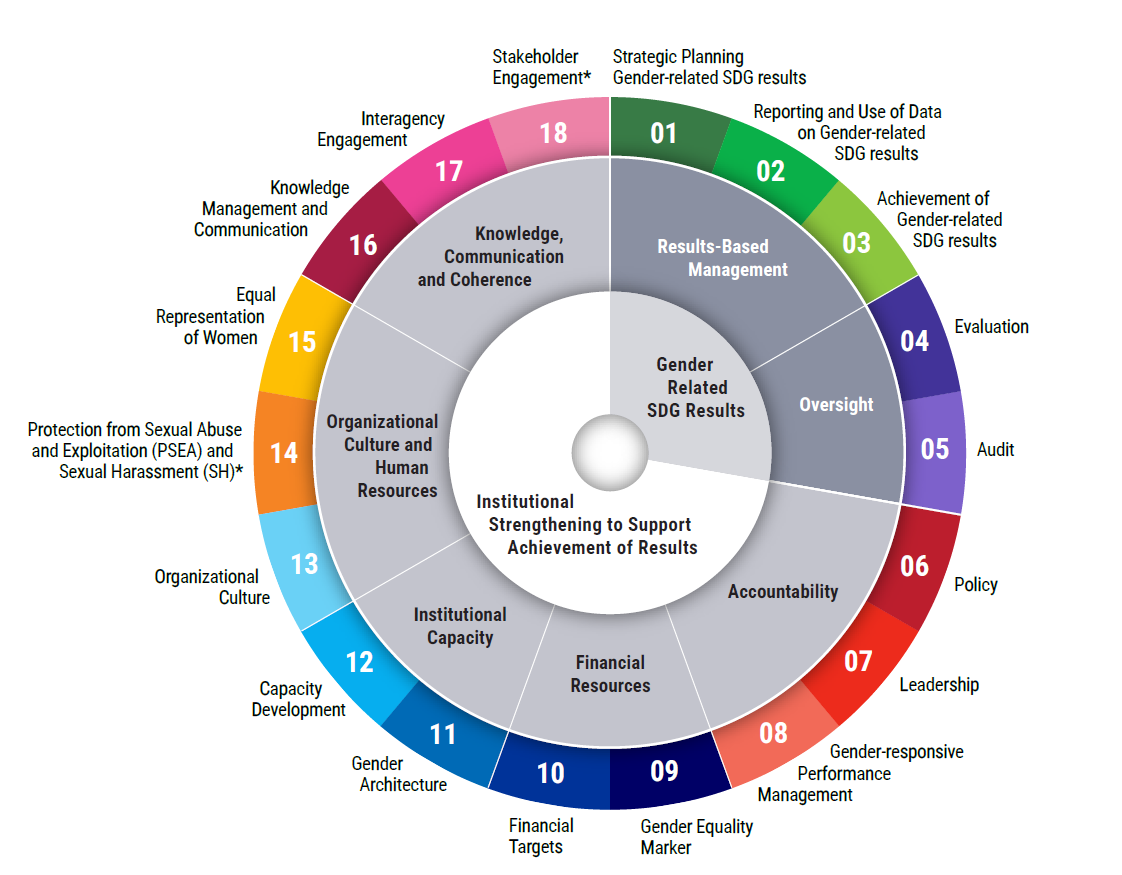
The UN-SWAP 3.0 requires an entity’s self-assessment against 18 common system-wide performance indicators clustered into seven broad functional areas: 1) Results-based management 2) Oversight 3) Accountability 4) Financial resources 5) Institutional capacity 6) Organizational culture and human resources 7) Knowledge, communication and coherence.
The UN-SWAP 2.0 framework was last updated in 2018, and the 3.0 version was introduced in 2024. The updated framework renews system-wide accountability for gender equality and the empowerment of all women and girls. It strengthens the link between institutional performance and gender-related results, promotes coherence across diverse mandates, and aligns with the Gender Equality Acceleration Plan (GEAP).
Click here for the latest UN-SWAP 3.0 reporting guidance.
Where We Stand
75 entities (96% of UN entities, corresponding to over 99% of the UN budget) reported on the UN-SWAP indicators in 2024 with 80% of ratings meeting or exceeding requirements
On a yearly basis, entities report on progress in implementing the gender mainstreaming strategy, using the UN-SWAP performance indicators. The aggregated progress of the reporting entities is provided to the Economic and Social Council (ECOSOC) annually through a report by the Secretary-General on mainstreaming a gender perspective into all policies and programmes in the UN system. UN Women’s Executive Director addresses an annual letter to the executive management of each reporting entity that contains an analysis of the progress made, comparisons to cohorts and suggestions for improvements to help meet the expected results in relation to each indicator.
The annual report cards are published yearly. 2024, 2023, 2022, 2021, 2020, 2019, 2018
Check the latest factsheet of UN system-wide progress, including entity list by a total of 51 achievement areas (from 2024 UN-SWAP reporting).
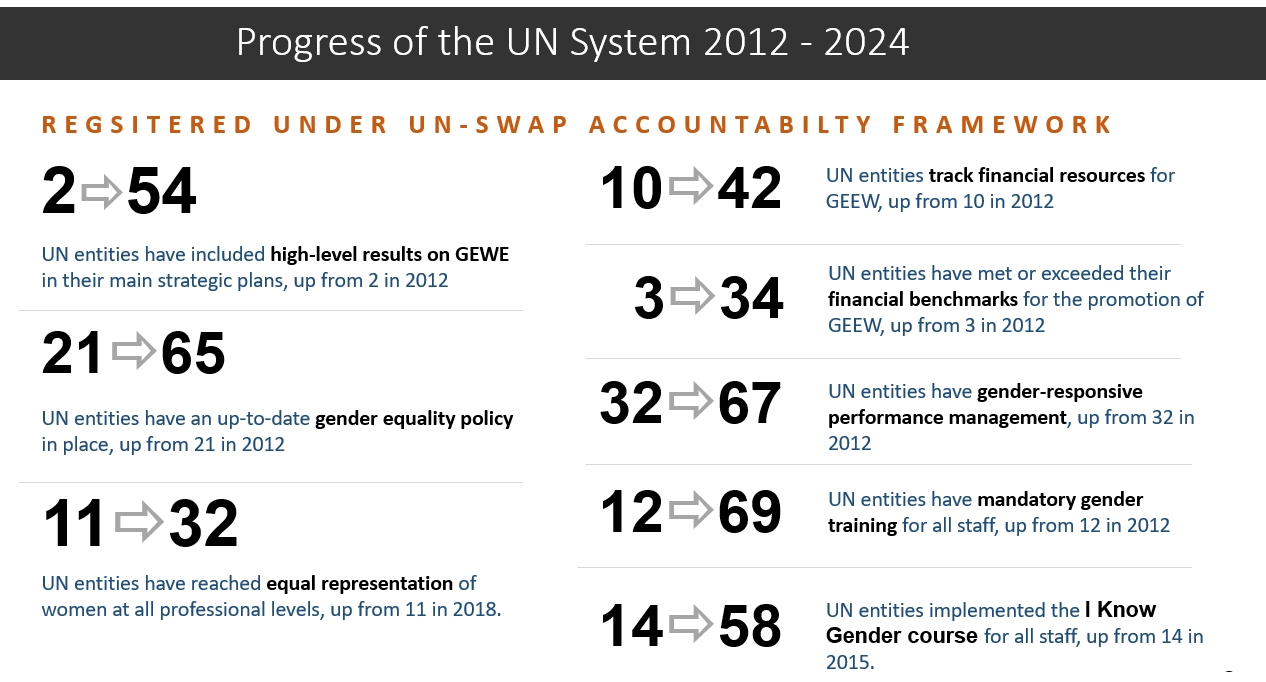
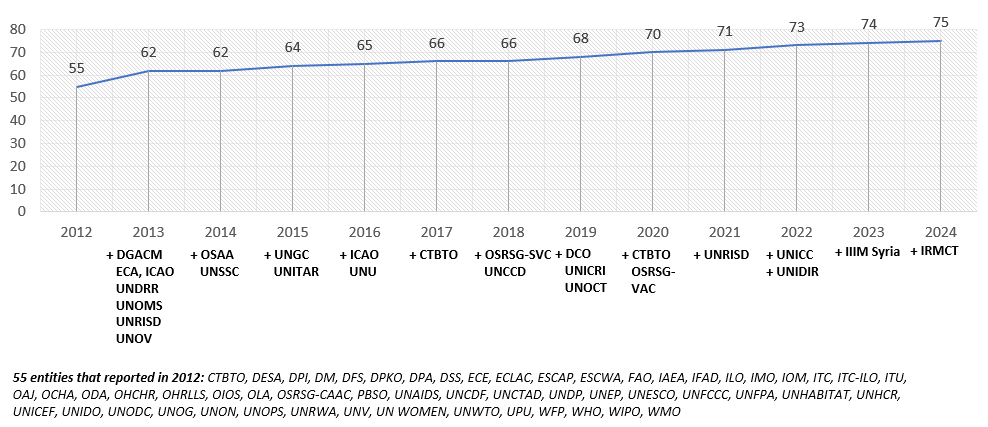
The UN-SWAP was developed through a series of system-wide consultations with more than 50 UN entities, including piloting with eight entities, IAEA, OHCHR, ESCWA, UNDP, UNFPA, UNICEF, UNAIDS and IOM. Since it's inception, the number of UN-SWAP participating entities has grown from 55 in 2012 to 75 in 2024. The system-wide compliance rate has increased from 31% in 2012 to 72% in 2024.

The growth of participating UN entities per year:
The UN-SWAP secretariat has supported 21 UN entities in developing and updating their gender equality policies since 2012.
The UN-SWAP secretariat has supported 38 peer reviews among participating UN entities.
2016: IOM and UNOPS
2018: UNDP and UNICEF; UNFPA and UN Women; DGACM and UNOMS
2019: DGC and DMSPC; FAO, IFAD and WFP; IOM and WFP; OLA and OHRLLS; UNAIDS and UNHCR
2020: UNIDO and UNODC/UNOV; UNWTO and WIPO; ITC and WHO; OCHA and ODA; DPO and DPPA
2021: DCO and UNFPA; DESA and Global Compact; UNCDF and UNV; UNDRR and UNEP; UNITAR and UNU; ESCAP and ESCWA
2022: ITU and UPU; DOS and DSS; OSRSG-VAC and OSRSG-CAAC
2023: UNON and UNOG; UNICRI and CTBTO; OHRLLS and UN Women; UNRWA and ESCWA; WIPO and IAEA; UNOCT and ODA; UNOPS and UN-Habitat; ECE and ECA; UNIDIR and IIIM-Syria; OHCHR-UNDP
2024: UNCTAD and ECLAC; DGC and DGACM; ICAO and IMO; FAO, IFAD and WFP
2025: UNICC and UN Women
Gender Equality Markers and Financial Targets
A growing call for systems that can track and promote financial investments in gender equality and women’s empowerment
Under the umbrella of the UN-SWAP, considerable efforts have gone into supporting UN entities to develop and adopt gender equality markers and financial targets to track and quantify the allocation of resources dedicated to gender equality. The UN-SWAP help desk supports UN entities in deploying gender equality markers (GEM) and establish financial targets. These markers are used to code or ‘mark’ projects, outputs or activities, signaling the extent to which interventions contribute to results or changes relating to gender equality and women’s empowerment.
In 2023, CEB-endorsed the Data standards for United Nations System-wide reporting of financial data with the gender marker as the 7th standard. This standard is being applied system-wide with a transitionary period of 3 years.
Gender Equality Architecture
The mapping and costing exercise of the gender architecture focuses on staffing standards, access to expertise, capacity to influence decision-making processes, and availability of financial resources to implement gender equality commitments
Without solid investment in gender equality expertise, results will remain elusive. The UN System Coordination Division of UN Women conducted a mapping and costing study of the gender architecture in the UN System from interviews and survey data for 2019-2021. Results showed that nearly 40% of the UN entities reported the expansion of gender unit work portfolios to address multiple cross-cutting issues, while 64% lack benchmarks on gender-related staffing due to funding limitations. Most UN entities also expressed the common challenges in placing gender resources and staffings organically across the HQ and field levels, and the difficulty in tracking and reporting expenditures on gender equality. Click to see the report and presentation with details and the associated recommendations.
Upgrade to UN-SWAP 3.0
The UN-SWAP 3.0 raises the bar for gender mainstreaming in the UN system, integrating actions from the Secretary-General System-wide Gender Equality Acceleration Plan (GEAP) and elevating the accountability framework requirements on the Beijing Declaration and Platform for Action and the SDG results for the run-up to 2030.
Visit the page for detailed information about the upgrade process in 2024.
Additionally, you can explore the visual that highlights the overlap of entities between UN-SWAP, UNSDG, and the GEAP Task Team.
Resources
Explore the library section to gain greater insight into how gender considerations are mainstreamed across key business functions in the UN system. The UN-SWAP secretariat also organizes periodic workshops and an annual conference where focal points can learn from each other about initiatives and approaches proven to be effective. The UN-SWAP reporting platform includes a knowledge hub that hosts a growing library of guidance notes, capacity-building materials, research reports and good practices from all participating UN agencies.
2025
UN-SWAP 2.0 entity performance results 2024
Seventy-five UN entities, which make up 96% of the UN system, reported against UN-SWAP 2.0 in 2024.
This web page contains a summary of 2024 UN system-wide reporting results, as well as the report scorecard per each individual entity.
2024
UN-SWAP 3.0 Peer Review Guidance
Guidance on the steps and content to consider when conducting a peer review under the UN-SWAP 3.0 accountability framework.
2021
Guidance on the preparation of a gender equality and the empowerment of women policy
Guidance on how to develop a UN-SWAP 2.0-aligned gender equality and empowerment of women policy at the corporate level
2020
Guidance on UN strategic planning and gender equality and the empowerment of women
Guidance on what to consider when developing a high-level result on gender equlity and the empowerment of women for the strategic plan, including examples from UN entities.
2022
UN-SWAP Good Practice 2022
Empowered by the UN-SWAP 2.0, UN Women is able to identify and coordinate the system-wide adoption of good practices and harmonized products that can be scaled from one entity to another. UN Women selects and publishes a series of good practices from various entities on annual basis, normally through the UN-SWAP review reports and the updated technical guidance. This catalog aggregates various best practices under UN-SWAP 2.0 indicators, updated in 2022.
Title
UN-SWAP Helpdesk
Serving as a central resource for GEWE at the corporate level, the UN-SWAP secretariat has provided direct support to reporting entities since 2013. Please contact the UN-SWAP secretariat via unswap.helpdesk@unwomen.org.