
Financing for gender equality is a necessary foundation for achieving gender equality and the em-powerment of women and girls.
Module 1 introduces key concepts and explains the rationale for implementing Gender Equality Marker Systems. It also gives an insight into the history of Gender Equality Markers in the UN System.
1.1 Gender Equality Markers & the UN System: A Chronology
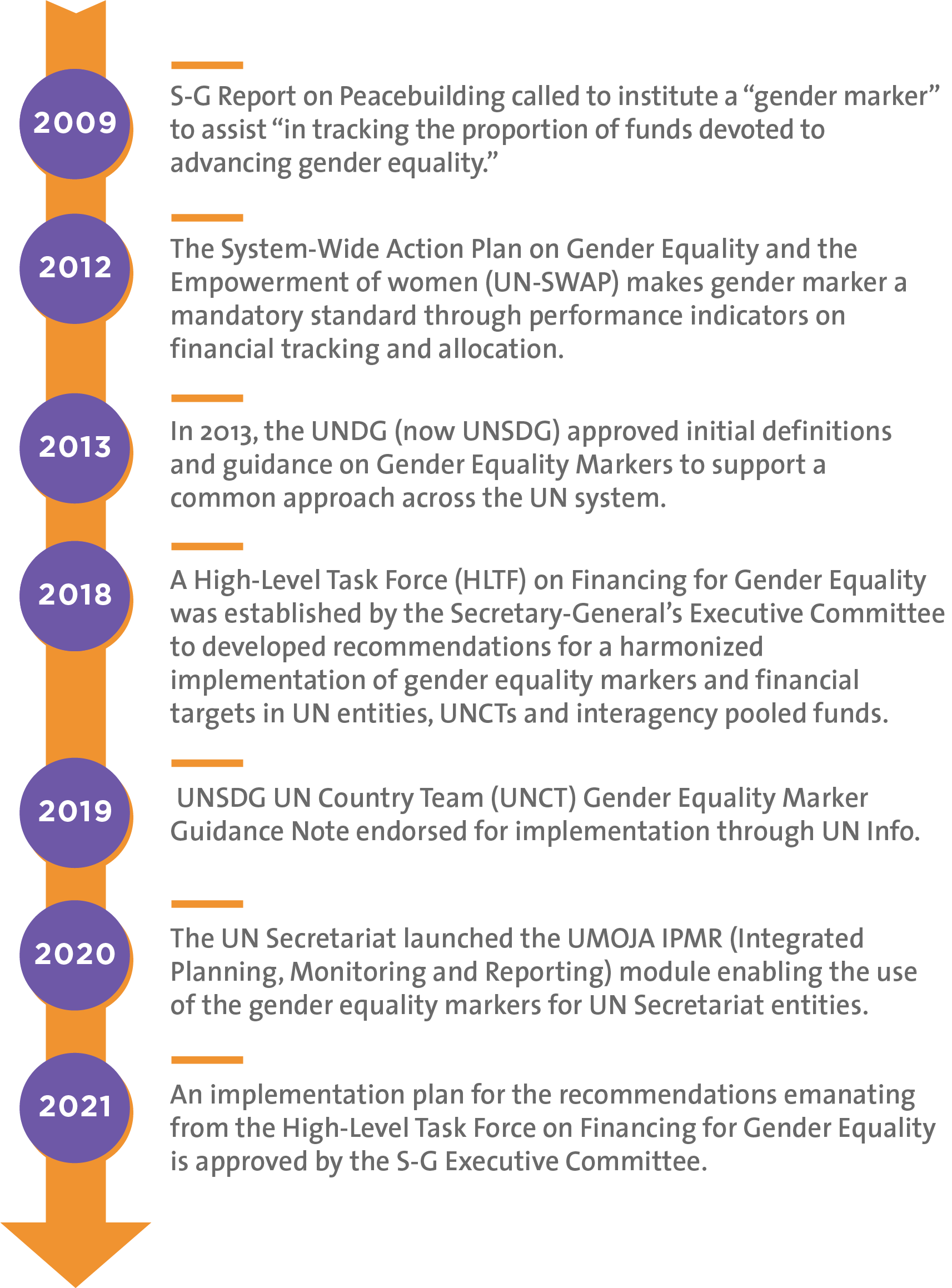
Financing for gender equality is a necessary foundation for achieving gender equality and the em-powerment of women and girls. It refers to increasing the quantity and quality of financial re-sources for gender equality so that normative commitments can be integrated into laws, policies, plans and budgets as well as implemented to achieve tangible results for women and girls.
Beginning in 2010, the Peacebuilding Fund and a few of the UN Funds and Programmes (UNDP, UNFPA and UNICEF) piloted the use of the gender equality marker (GEM) in response to the Secre-tary-General’s Seven Point Action Plan. In this Plan, the Secretary- General called for at least 15% of UN-managed funds in support of peacebuilding to be dedicated to projects whose principal objec-tive is to address women’s specific needs as well as to advance gender equality and the empower-ment of women.
By 2012, the gender equality marker as well as the setting of financial targets on gender equality became mandatory standards under the System-wide Action Plan on Gender Equality and the Em-powerment of Women (UN-SWAP). They continue to be mandated annually by the Economic and Social Council (ECOSOC) in its resolutions on mainstreaming a gender perspective into all policies and programmes in the United Nations system as well as in General Assembly resolutions on the Quadrennial Comprehensive Policy Review (QCPR). Through the UN System-Wide Action Plan on Gender Equality and the Empowerment of Women (UN-SWAP), which has transformed the way in which gender equality work is carried out in the UN system, several entities developed gender policies as well as integrated gender equality in their strategic plans and results-based management systems. These policies and plans have helped entities to better prioritize gender equality in their work using a twin-track approach to gender mainstreaming, which combines a mix of dedicated gender equality interventions with integrated approaches in programme portfolios and budgets.
In 2013, the United Nations Development Group (now the United Nations Sustainable Development Group (UNSDG)) approved initial definitions and guidance on Gender Equality Markers to support a common approach across the UN system for the purposes of comparability. The guidance was further updated in 2018 when the CEB Finance and Budget network endorsed guidance on coding definitions and quality assurance for gender equality markers.
In 2018 the Secretary-General’s Executive Committee convened a High-Level Task Force (HLTF) on Financing for Gender Equality to address the persistent under-resourcing of the gender equality agenda. The HLTF was tasked with reviewing and tracking budgets and expenditures across the UN system and making recommendations on how to increase financing for gender equality, including by identifying structural and operational changes required to enable financial tracking. The HLTF adopted six recommendations aimed at increased coordination, consistency and comparability across the UN-System and at complementing the Secretary-General’s Strategy for Financing the 2030 Agenda for Sustainable Development. Key objectives include harmonizing gender equality markers and financial targets and increasing funding for gender-related programming.
In 2023, CEB-endorsed the Data standards for United Nations System-wide reporting of financial data with the gender marker as the 7th standard. This standard is being applied system-wide with a transitionary period of 3 years.
1.2 Key Concepts and Definitions
Key concepts underpinning gender equality markers include:
Additional Resources
UN Women, Gender Equality Glossary
UNICEF, Glossary of Terms and Concepts
Key acronyms in the context of Gender Equality / Gender Equality Markers:
- ERP - Enterprise Resource Planning
- GEWE - Gender Equality and Women’s Empowerment
- GEM - Gender Equality Marker
- GAM - Gender with Age Marker
- GM - Gender Mainstreaming
- UN-SWAP - System Wide Action Plan on Gender Equality and the Empowerment of Women
- IPMR - Integrated Planning, Management and Reporting
- MPTF - Multi-Partner Trust Fund
- UNDG - United Nations Development Group (now the United Nations Sustainable Development Group -UNSDG-)
For acronyms on UN entities, please see the organizational chart.