The United Nations Country Team System Wide Action Plan Gender Equality Scorecard (UNCT-SWAP) focuses on improved UNCT planning, coordination, programming, resources and results for gender equality and the empowerment of women and girls.
In 2008, the UN Development Group (now UN Sustainable Development Group) endorsed the UNCT Gender Equality Scorecard, which put forward minimum gender mainstreaming requirements for UNCT joint processes and institutional arrangements. Updated in 2018 to cover results tied to the SDGs and to align with the UN System-wide Action Plan (UN-SWAP) at the entity level, the framework is now known as the UNCT-SWAP Gender Equality Scorecard (UNCT-SWAP).
UNCT-SWAP reporting takes place through comprehensive reports at the Cooperation Framework planning stage and through annual progress reports. Action planning and reporting is part of the assessment.
Legislative Basis
The 2030 Agenda for Sustainable Development provides the guiding vision for the UN’s work to achieve gender equality and the empowerment of women and girls. The 2020 Quadrennial Comprehensive Policy Review and the 2021 ECOSOC resolution on gender mainstreaming provide specific policy direction, calling on the UN development system to enhance and accelerate gender mainstreaming through the full implementation of the UNCT-SWAP. Updated in 2018 and in 2023, the UNCT-SWAP Framework and Technical Guidance incorporates a detailed list of relevant UN mandates and commitments.
Gender Mainstreaming Standards
Performance Indicators set gender mainstreaming standards
The UNCT-SWAP is organized around seven performance dimensions and fifteen measurable performance indicators. The performance indicators are drawn from intergovernmental mandates. UNCTs need to meet or exceed the standards set out by these indicators. The self-assessment focuses on collective performance and is conducted in a participatory manner and led by an inter-agency assessment team. The findings feed into an action plan designed to maintain and improve performance.
Where We Stand
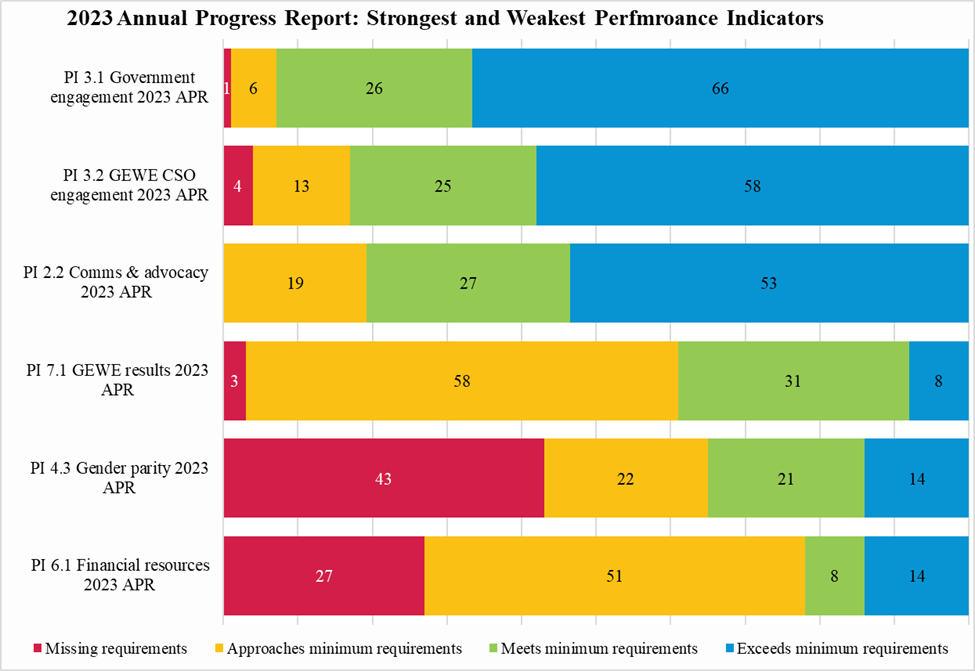
UNCTs’ engagement with governments is strong, but financial resources and gender parity remain a challenge.
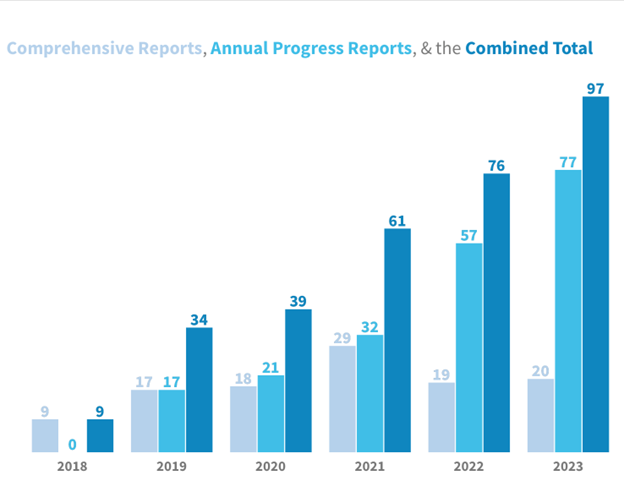
The number of UNCTs reporting annually is steadily increasing, 97 UNCTs submitted a UNCT-SWAP report in 2023, compared to 9 in 2018.
UNCT-SWAP reporting takes place through Comprehensive Reports (CR) at the Cooperation Framework planning stage and then, since 2019, through Annual Progress Reports (AR). Action planning and reporting are both part of the assessment.
The number of UNCT reporting on UNCT-SWAP has increased on a year-on-year basis, fueled in large part by the introduction of Annual Reporting in 2019, to compliment what has since been defined as Comprehensive Reports.
In the period 2018-2023, UNCT-SWAP reporting rose almost tenfold. Altogether, 112 out of 132 UNCTs completed a Comprehensive Report, which represents 85% of UNCTs. The number of UNCTs submitting an Annual Report has increased from 17 in 2019 to 77 in 2023, with new UNCTs being ‘onboarded’ each year from the previous year’s CR submissions and others continuing with a new round of AR or moving from annual reporting to prepare their next CR.
The following map depict the implementation of the UNCT-SWAP Annual Progress and Comprehensive Reports by UNCTs across all regions. UNCTs are supported by UN Women through engagement in country, through UN Women’s regional offices and through UN Women’s UNCT-SWAP Global Secretariat located in UN Women’s headquarters.
At the global level, the UNCT-SWAP informs QCPR reporting (indicator 1.4.15) including as part of Secretary General’s annual report on gender mainstreaming presented to Member States.
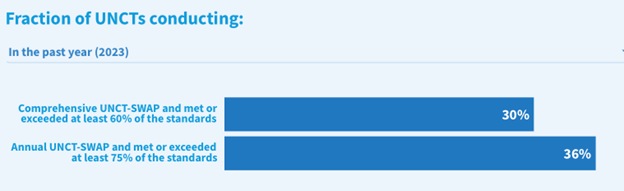
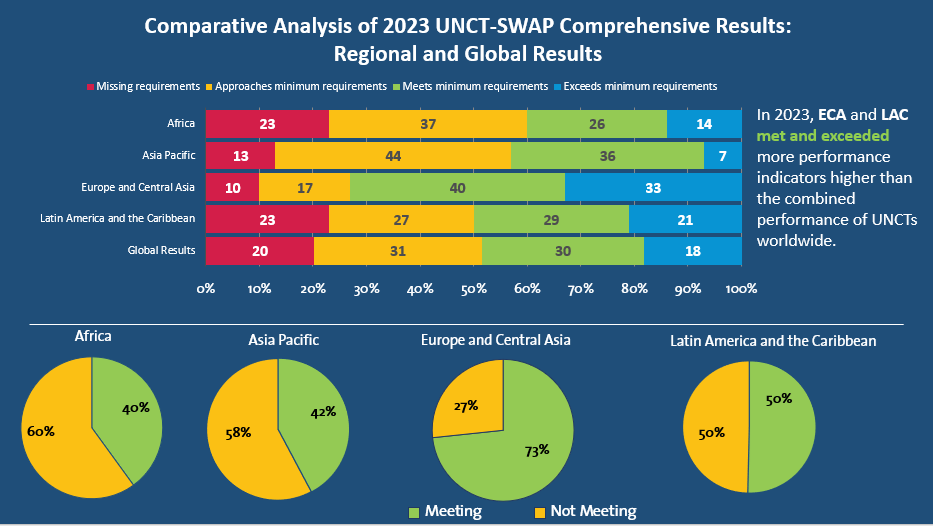
As the first graph below shows, 30% of the UNCTs that undertook a comprehensive report in 2023, met or exceeded 60% of all UNCT SWAP requirements (6 out of 20); 36% of UNCTs that conducted an AR met or exceeded 75% of the UNCT SWAP minimum requirements (28 out of 77).
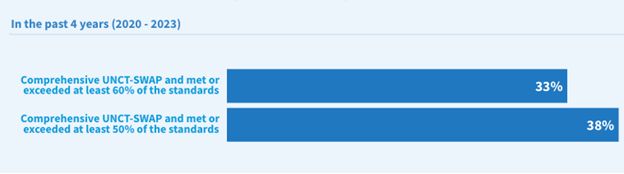
The historical trend shows that 38% of the UNCTs that completed a comprehensive assessment over the last 4 years met or exceeded at least 50% of the UNCT SWAP standards (32 out of 85); and 33% met or exceed 60% of the UNCT SWAP requirements (28 out of 85).
UNCTs' engagement with governments is strong, but financial resources and gender parity remain a challenge.
2023 Annual Progress Results:
Strongest and Weakest Performance Indicators by Percentage of Countries
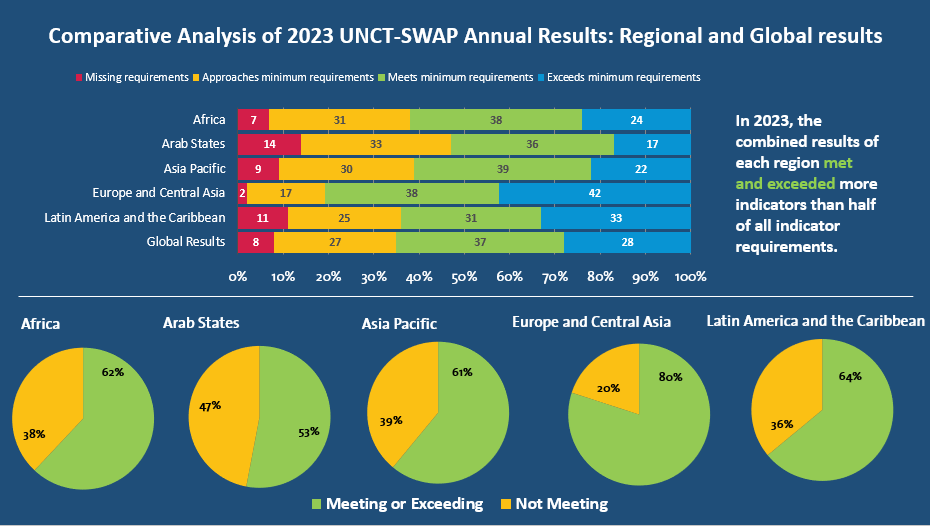
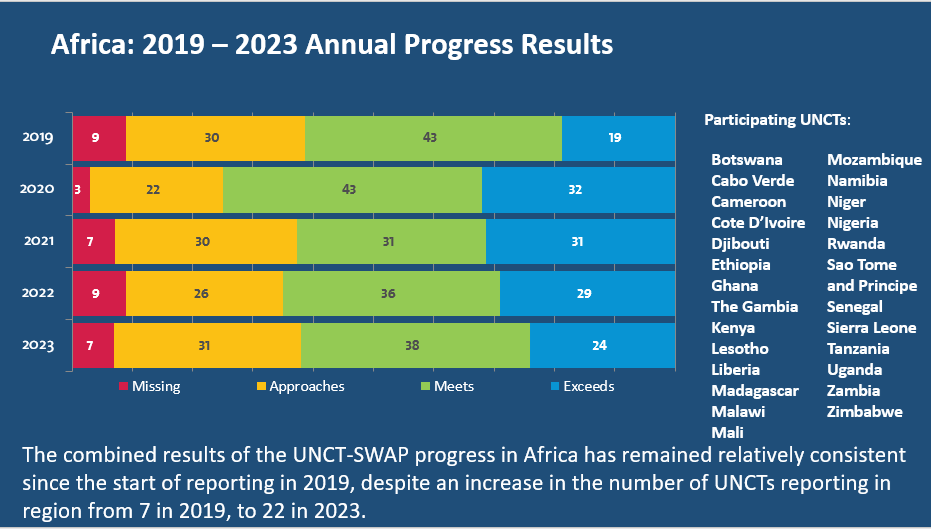
A closer look at UNCT-SWAP results by region, including areas of strength and opportunity, is presented below.
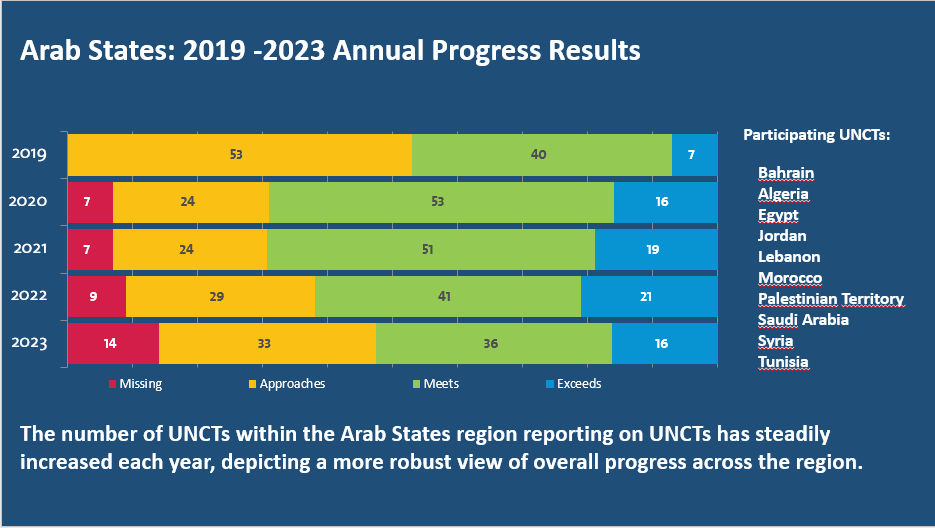
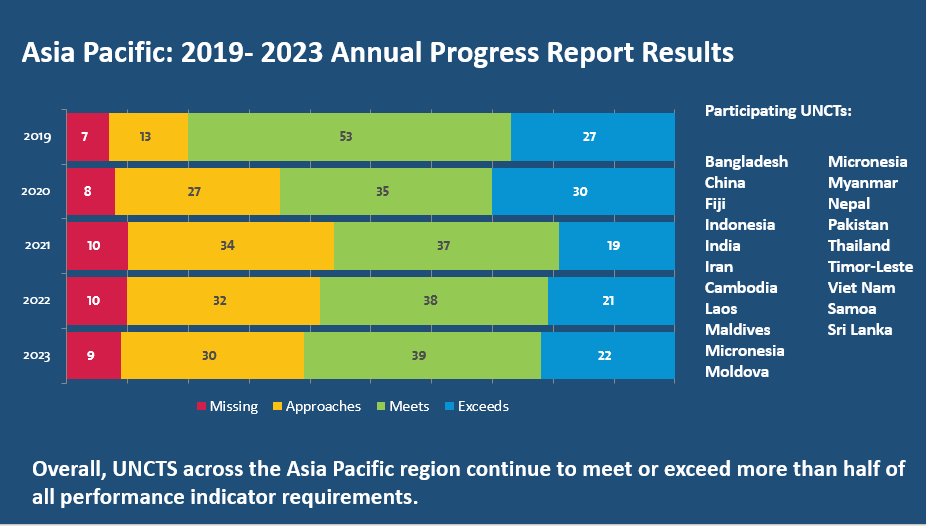
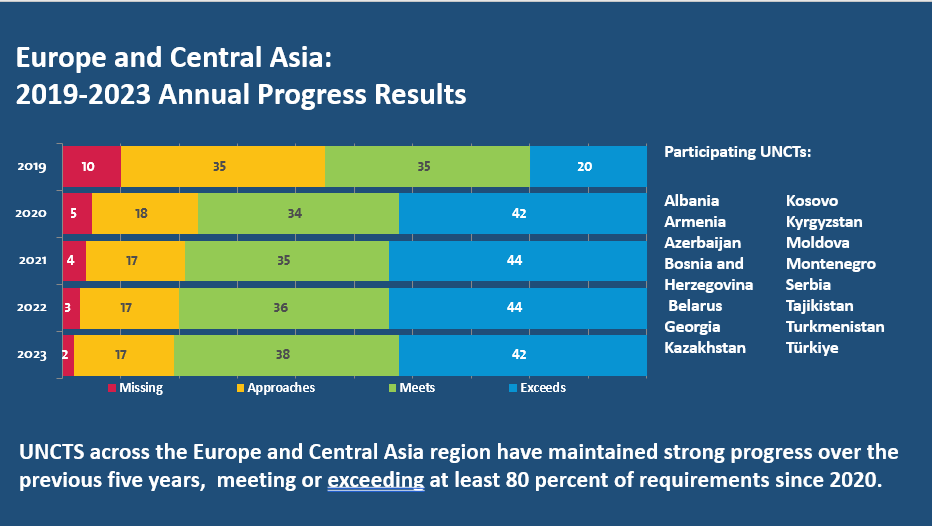
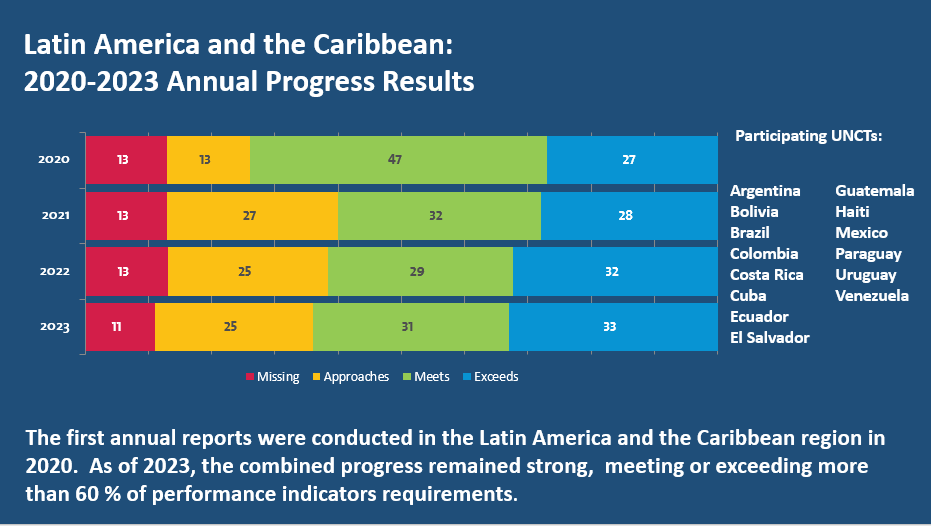
UNCT Gender Equality Marker
Increased application of the UNCT Gender Equality Marker (GEM) by UNCTs in UN INFO
The UNCT-GEM was first introduced in 2018 in conjunction with the rollout of UN INFO, the online planning, reporting and monitoring platform that digitizes the cooperation framework. The gender marker is applied to sub-outputs using a four-point coding scale to determine the extent to which sub-outputs contribute to gender equality. This provides a tool to track UNCT funding to gender equality-focused activities. UNCT Joint Work Plans in UN INFO incorporate a mandatory UNCT-GEM reporting field.
At the UN Country Team (UNCT) level, by 2023, 91 UNCTs have applied the UNCT GEM in their Joint Work Plan, up from 63 UNCTs in 2021 and 43 UNCTs in 2020.
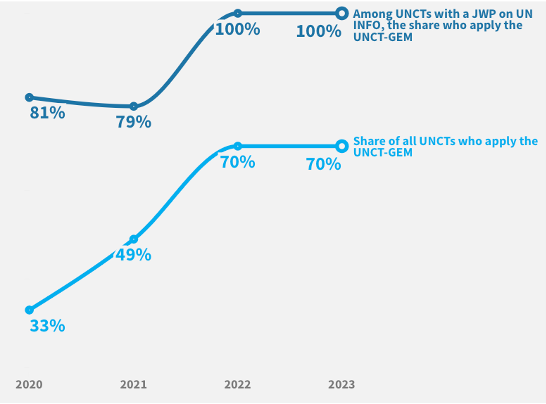
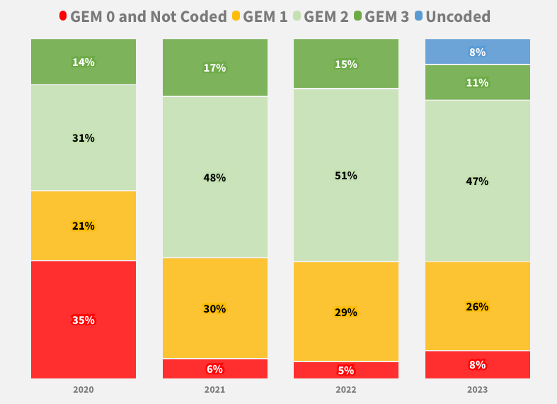
UNCT-GEM Global Trend Analysis 2020-2023
An average of 58% of UNCT funding frameworks were dedicated to sub-outputs with UNCT-GEM 2 (gender equality as a significant objective) and UNCT-GEM 3 (gender equality as principal objective) in 2023.

Financial Targets for Gender Equality
Financial target linked to the UNCT GEM
The 2020 QCPR Monitoring Framework includes the following indicator:
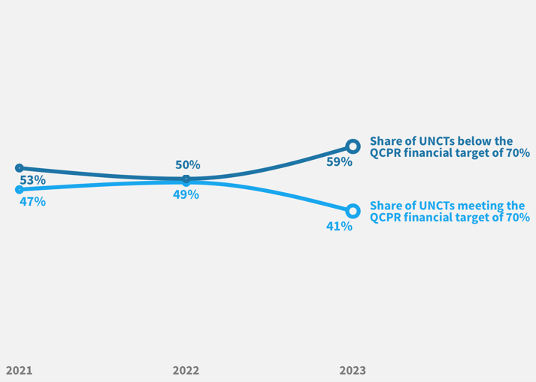
Proportion out of total UNCTs with a Joint Work Plan in UN INFO 2.0 that allocated [70%] or more of the UNCT annual funding framework available resources to activities with gender equality as a principal or significant objective.
In 2023, 43 UNCTs (41%) reported to reach this target, up from 26 UNCTs (41%) in 2021.
Resources
Together with UN Women Regional Offices and in collaboration with UN entities, UN Women’s UN system coordination division supports the development of guidance and technical tools for implementing the UNCT-SWAP and the UNCT GEM. These products are developed through a consultative process and many benefit from direct inputs and feedback from UNCTs.
2023
UNCT-SWAP Gender Equality Scorecard
The UNCT-SWAP Scorecard is a standardized assessment of UN country-level gender mainstreaming practices and performance that is aimed at ensuring accountability of senior managers and improving UNCT performance.
2024
UNCT Gender Equality Marker Guidance Note (2024)
This guidance support UNCTs in the application of the GEM within UN INFO and the UNSDCF. The UNCT GEM tracks the resources allocated collectively by the UN system under the UNSDCF cycle, making clear the level of commitment and the degree of resources allocated by the UNCT in support of national GEWE priorities.
2024
UN Gender Theme Group: Good Practice Compendium
The UN Gender Theme Group Good Practice Compendium (2024) is a collection of examples from UN Country Teams collected during the rollout of the UNSDG Gender Theme Groups Standards and Procedures in 2022-2023. More than 300 UN colleagues at country level participated in the rollout, managed by UN Women and DCO regional offices with the support of UN Women's UN System Coordination Division, in close collaboration with DCO, UNICEF, UNDP, UNFPA, representing the UN Gender Equality Network, at a global level. The good practices are meant to strengthen the system-wide impact, efficiency, and results for gender equality led by Gender Theme Groups, currently operational in more than 100 country teams globally. The compendium provides useful and hands-on examples for the effective function and operation of Gender Theme Groups.
Title
Latest News
forthcoming
Title
Global helpdesks
Support for implementing the UNCT-SWAP and the UNCT GEM is available to UNCTs through global helpdesks:
UNCT-SWAP: genderscorecard.helpdesk@unwomen.org
UNCT GEM: UNCT-GEM.helpdesk@unwomen.org